Book · Copy supplied by the author
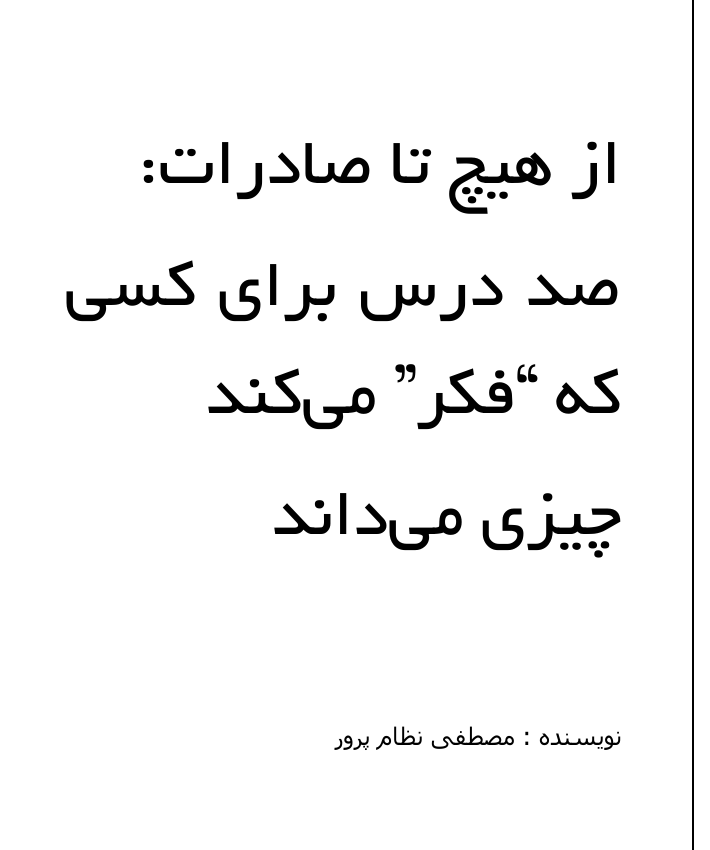
From Nothing to Exports
English translation of the author’s Persian text. Source-page references refer to the original edition.
One Hundred Lessons for Someone Who “Thinks” They Know Something
Author: Mostafa Nezamparvar
Full book contents
100 lessons, an introduction, 14 interludes and 7 appendices, each on its own page. The complete text of each section has been transferred from the copy supplied by the author.
Dedicated illustrations: 122 of 122 sections are ready; every section has its own illustration.
- A Bitter Truth — Page 2Page 2
- IntroductionPages 3 and 4
- Lesson 1Page 5
- Lesson 2Page 6
- Lesson 3Page 7
- Lesson 4Page 8
- A Bitter Truth — Page 9Page 9
- Lesson 5Page 10
- Lesson 6Page 11
- Lesson 7Page 12
- Lesson 8Page 13
- A Bitter Truth — Page 14Page 14
- Lesson 9Page 15
- Lesson 10Page 16
- Lesson 11Page 17
- Lesson 12Page 18
- A Wake-Up Call — Page 19Page 19
- Lesson 13Page 20
- Lesson 14Page 21
- Lesson 15Page 22
- Lesson 16Page 23
- A Wake-Up Call — Page 24Page 24
- Lesson 17Page 25
- Lesson 18Page 26
- Lesson 19Page 27
- Lesson 20Page 28
- A Wake-Up Call — Page 29Page 29
- Lesson 21Page 30
- Lesson 22Page 31
- Lesson 23Page 32
- Lesson 24Page 33
- Lesson 25Page 34
- Lesson 26Page 35
- A Wake-Up Call — Page 36Page 36
- An Aside — Page 37Page 37
- Lesson 27: Market ResearchPage 38
- Lesson 28: Financial PlanningPage 39
- Lesson 29: Understanding and Complying with Customs and Tax LawsPage 40
- Lesson 30: Choosing Transport MethodsPage 41
- Lesson 31: Using InsurancePage 42
- Lesson 32: Competitor AnalysisPage 43
- Lesson 33: Using Trade AgreementsPage 44
- Lesson 34: Using Digital MarketingPage 45
- Lesson 35: Building a Strong NetworkPage 46
- A Wake-Up Call — Page 47Page 47
- Lesson 36: Developing a Market Entry StrategyPage 48
- Lesson 37: Risk ManagementPage 49
- Lesson 38: Building a Distribution NetworkPage 50
- Lesson 39: Analyzing Target MarketsPage 51
- Lesson 40: Using New Technologies in ExportsPage 52
- Lesson 41: Understanding International StandardsPage 53
- Lesson 42: Setting Export PricesPage 54
- Lesson 43: Attending Exhibitions and Trade EventsPage 55
- Lesson 44: Quality ControlPage 56
- Lesson 45: Forecasting Currency FluctuationsPage 57
- A Wake-Up Call — Page 58Page 58
- Lesson 46: Using International Contracts and IncotermsPage 59
- Lesson 47: Choosing a Reliable Payment SystemPage 60
- Lesson 48: Building a Strong BrandPage 61
- Lesson 49: Establishing an Internal Quality-Control UnitPage 62
- Lesson 50: Analyzing Competitors and Creating DifferentiationPage 63
- Lesson 51: Understanding E-Commerce LawsPage 64
- Lesson 52: Designing a Content Marketing StrategyPage 65
- Lesson 53: Using CRM ToolsPage 66
- Lesson 54: Consistent Follow-UpPage 67
- Lesson 55: Following Up on International PaymentsPage 68
- A Wake-Up Call — Page 69Page 69
- Lesson 56: Managing Exchange-Rate ChangesPage 70
- Lesson 57: Using Logistics SystemsPage 71
- Lesson 58: Optimizing the Supply ChainPage 72
- Lesson 59: Developing a Global Marketing StrategyPage 73
- Lesson 60: Contract ManagementPage 74
- Lesson 61: Assessing Market PotentialPage 75
- Lesson 62: Using Psychological Pricing TechniquesPage 76
- Lesson 63: Developing Cross-Cultural CommunicationPage 77
- Lesson 64: Using ERP SystemsPage 78
- Lesson 65: Following Ethical Principles in TradePage 79
- A Wake-Up Call — Page 80Page 80
- Lesson 66: Analyzing Strengths, Weaknesses, Opportunities and ThreatsPage 81
- Lesson 67: Using Advanced Negotiation TechniquesPage 82
- Lesson 68: Managing International DebtPage 83
- Lesson 69: Learning Foreign LanguagesPage 84
- Lesson 70: Managing Digital AssetsPage 85
- Lesson 71: Using E-Commerce PlatformsPage 86
- Lesson 72: Understanding Different Business CulturesPage 87
- Lesson 73: Managing Business ConflictsPage 88
- Lesson 74: Using Artificial Intelligence Tools in TradePage 89
- Lesson 75: Understanding International Financial ConceptsPage 90
- Lesson 76: Creating an Export Business PlanPage 91
- Lesson 77: Researching Target CustomersPage 92
- Lesson 78: Developing New Products for ExportPage 93
- Lesson 79: Managing Product ReturnsPage 94
- Lesson 80: Taking Specialist Export CoursesPage 95
- A Wake-Up Call — Page 96Page 96
- Lesson 81: Creating Multiple Distribution ChannelsPage 97
- Lesson 82: Using Export Tax ModelsPage 98
- Lesson 83: Using Diplomatic Trade RelationsPage 99
- Lesson 84: Using Global Marketing PlatformsPage 100
- Lesson 85: Creating Customer Loyalty ProgramsPage 101
- Lesson 86: Examining Competitors in International MarketsPage 102
- Lesson 87: Developing Data-Driven Export StrategiesPage 103
- Lesson 88: Managing Political and Economic ChangesPage 104
- Lesson 89: Optimizing Export PackagingPage 105
- Lesson 90: Using Automation SystemsPage 106
- Lesson 91: Creating Internal Training ProgramsPage 107
- Lesson 92: Developing Environmentally Friendly ProductsPage 108
- Lesson 93: Joining International Associations and Chambers of CommercePage 109
- Lesson 94: Using Export InsurancePage 110
- Lesson 95: Forecasting Future Market TrendsPage 111
- Lesson 96: Building IT InfrastructurePage 112
- Lesson 97: Meeting International Quality StandardsPage 113
- Lesson 98: Developing Performance Evaluation SystemsPage 114
- Lesson 99: Managing Cultural RiskPage 115
- Lesson 100: Keep LearningPage 116
- A Wake-Up Call — Page 117Page 117
- Appendix 1: Useful Resources for New ExportersPage 118
- Appendix 2: Examples of Successes and FailuresPage 119
- Appendix 3: Final Export ChecklistPage 120
- Appendix 4: Export Terms and KeywordsPage 121
- Appendix 5: Sample Contracts and Customs FormsPage 122
- Appendix 6: Organizations and Agencies That Assist ExportersPage 123
- Appendix 7: Guidance for Times of CrisisPage 124
About the book
This book presents 100 short lessons drawing attention to different aspects of exporting. In a conversational style with critical humor, it challenges expectations of quick, effortless success and emphasizes learning, understanding markets and being prepared for difficulties.
The book covers product selection, negotiation and language, marketing and networking, planning, packaging and distribution, payment methods and risk management. It ends with a checklist and questions for reviewing export readiness. This introduction is based on the copy supplied by the author; it does not confirm that every legal or financial point in the book remains current.
Excerpts from the book
The excerpts below are quoted from the copy supplied by the author; page numbers refer to that same 124-page file. Only spacing and punctuation have been standardized for web display.
Simply making your product and sending it to another country is not enough. You need to know how to distribute it in the target market. From wholesale to retail, or even online sales, you need to know which route works best for your product.
Perhaps this is the most important lesson. The world of trade and exports is constantly changing, and if you cannot adapt, you will fall behind.
Have you identified your target market?
Is your product packaging suitable?
Is your pricing realistic?
Have you chosen suitable transport methods?
Do you have a plan for potential risks?
This section is quoted from the book, not an up-to-date legal or financial guide. The complete PDF has not been made available for download.
Book topics
Product and market
Product selection, understanding the target market, advertising and distribution channels.
Communication and sales
Negotiation, language, networking and customer relationships.
Putting exports into practice
Packaging, transport, familiarity with customs and planning.
Money and risk
Payment methods, exchange-rate fluctuations, insurance and crisis management.
Details of the copy reviewed
- Full title
- From Nothing to Exports: One Hundred Lessons for Someone Who “Thinks” They Know Something
- Author
- Mostafa Nezamparvar
- Language
- Persian
- Number of pages in the file
- 124 pages
- Publisher, publication year and ISBN
- Not specified in the supplied copy.
Choose a chapter from the contents to read the book.