Educational article with video
Selling Food in the UAE: Hypermarkets, Local Stores and Wholesale
A detailed guide to four food-sales channels in the UAE based on Mostafa Nezamparvar's explanations: large hypermarkets, discount stores, local shops and wholesalers, comparing customers, goods, entry and payment.
Based on a talk by Mostafa Nezamparvar

Full article contents
- The UAE food-sales market is not uniform
- Large hypermarkets: familiarity does not mean easy entry
- Discount stores: price and product mix matter
- Local shops: nearby access does not necessarily mean quick sales
- Shelf-based wholesale: meeting several needs in one visit
- Do not compare four channels using one criterion
- Which differences should we assess when choosing a sales channel?
- About this talk
Full lesson video
Overview of the lesson's topics
The UAE food-sales market is not uniform
Knowing a few large store names is insufficient for selling food in the UAE. Store types, customers, product ranges and supplier-cooperation terms differ.
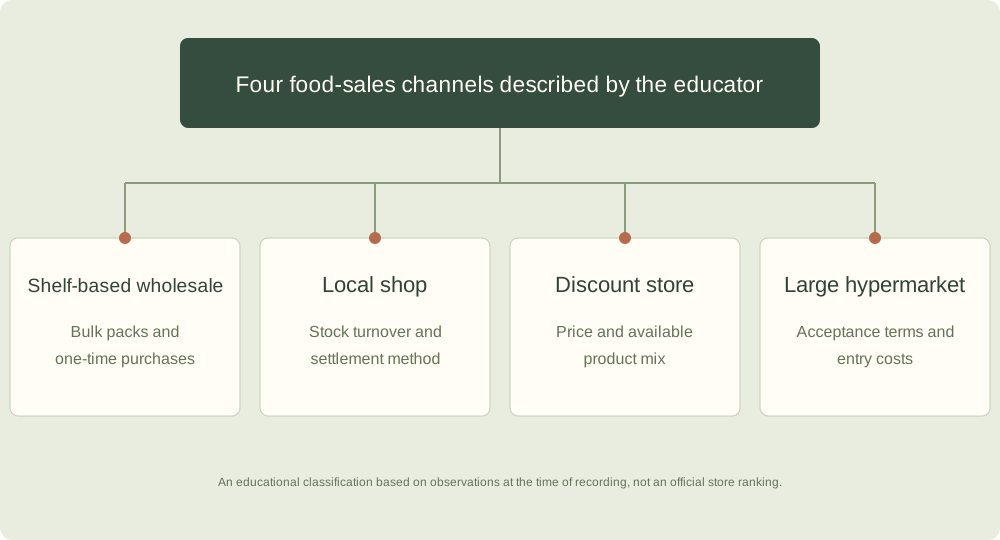
In this video, Mostafa Nezamparvar distinguishes large hypermarkets, discount stores, groceries and small local shops, and wholesalers offering in-person shelf shopping.
The video calls the first three groups Classes A, B and C. These are the educator's descriptive categories, not an official ranking or quality standard.
The order of presentation does not indicate sales priority. The central question is which channel best fits your product and supply capabilities.
Four sales channels; four kinds of assessment
Large hypermarket
A familiar network with multiple branches; examine product-acceptance terms and entry costs.
Discount store
Price-focused; examine the food share and suitability of shelf-stable goods.
Local shop
Limited everyday purchases; assess turnover and payment collection.
Shelf-based wholesale
Bulk and multi-item purchasing in one visit; assess packaging and professional customers.
Large hypermarkets: familiarity does not mean easy entry
Familiar retail chains are often sellers' first image of the UAE market. The video names Lulu, Union and Nesto. Branch counts and locations may attract suppliers, but seeing a large store is not the same as understanding its product-entry conditions.
The educator describes harder entry conditions and fees or membership charges for this group. Before cooperating, establish that organisation's product-acceptance terms and costs. The video discusses their existence, not a uniform amount, contract or rule for every store.
In this description, branch location and customer type affect the store's position. The educator compares its prices with discount stores, but this should not become a quality ranking for all its goods. For a supplier with a specific product, understanding the relevant department and buyer is more useful than the organisation's overall reputation.
Visibility and sales volume are another important distinction. The video explicitly says precise figures comparing this group's sales with the others are unavailable.
Store appearance, brand reputation or location alone cannot establish that goods will sell more. The educator's observations about visitors do not replace sales data.
Discount stores: price and product mix matter
The second group comprises stores known for discounts and lower prices. The educator describes busy customer traffic at some, particularly at night. This reflects observations of part of the market at recording time, not every branch or period.
In the session's observations, some stores in this group stay open long hours or around the clock. Queues and heavy traffic at certain times are among the reasons the educator considers this segment noteworthy.
A busy store alone does not establish that your food product will sell quickly; examine its product mix and the role of its food business.
The product mix varies. Some stores focus on clothing, kitchenware and non-food consumer goods, offering food alongside them.
Some businesses have more active food sections; others carry a narrower food range. Belonging to this group therefore does not establish suitability for every food product.
The educator describes some of these stores as carrying fewer fresh products such as fruit and vegetables and more longer-lasting goods. Suppliers need to establish what a store actually sells and whether their product fits its presentation model.
The educator describes cooperation with this group as simpler than with large hypermarkets. This does not guarantee acceptance; check the particular store's terms. Lower entry barriers alone guarantee neither order volume, repeat purchases nor the relationship's outcome.
Local shops: nearby access does not necessarily mean quick sales
The third group comprises groceries and small neighbourhood shops. In the video, they carry narrower ranges and serve nearby customers' daily or immediate needs. Their role differs from stores visited for larger household shopping trips.
From his experience, the educator reports slower sales and collection difficulties in some of these shops, while noting that conditions vary by location. This should not become a blanket judgement about all small retailers.
The educator links payment difficulties to how some small stores are managed: collecting receivables may depend on one person's presence and decisions, without a regular settlement process.
This describes his experience, not a fixed characteristic of every grocery. Distinguish neighbourhood customer presence from predictable cooperation with the store owner.
Store count alone is insufficient to assess this route. Consider turnover and settlement. A large network may disappoint suppliers' expectations if each outlet sells little or pays late.
Shelf-based wholesale: meeting several needs in one visit
The fourth group consists of wholesalers turning warehouses or sheds into shelf-based, walk-in shopping spaces. Customers can select several needed items in one place rather than visit separate suppliers. Combining varied needs into one visit is the distinguishing feature described.
Restaurants, cafés and hotels are named as customers for this model. Examples include large rice packages and bulk cleaning products. Large families may also shop at such centres.
This group is therefore more than a larger-looking store; packaging size and customers' intended use matter too.
The educator views the model favourably for convenient sourcing and fewer trips between suppliers. This explains its benefit, not statistical market share or profitability. Suppliers should ask whether their product and packaging fit bulk purchasing and these customers' needs.
Do not compare four channels using one criterion
Four comparison mistakes
- Branch count alone may make a large chain look more attractive while product-acceptance costs and conditions remain unexamined.
- Choosing solely for easy entry may favour a discount store whose main focus is non-food goods.
- Looking only at the number of local shops overlooks each shop's purchase quantity and payment timing.
- Focusing solely on wholesale volume can overlook whether packaging suits customers' consumption.
These differences explain the opening emphasis that the groups are not listed by priority. Each poses different questions for suppliers. Selection becomes clearer when the product and actual terms with several relevant customers are assessed, rather than calling one of the four categories universally best.
From understanding the product to choosing where to sell
1. Product type
Fresh, shelf-stable or suited to bulk consumption?
2. The outlet's customer
Households, immediate local purchases, or restaurants and hotels?
3. Supply fit
Do product variety and packaging format fit the outlet?
4. Cooperation terms
What are the product-acceptance terms, entry costs, sales turnover and payment conditions?
Which differences should we assess when choosing a sales channel?
The lesson concludes that UAE-market decisions should not rely solely on store reputation or outlet count. Large hypermarkets may impose harder entry conditions; discount stores may focus on price and shelf-stable goods; local shops may have slower turnover and different payment terms; shelf-based wholesalers serve bulk and multi-item purchases.
Several practical questions follow from the comparison:
Questions for choosing a channel
- Who is the store's main customer?
- What goods are sold there?
- Does your product fit the existing range and packaging?
- What are the entry and cooperation terms?
- How fast do goods sell, and how is payment made?
Answer these questions for the actual business you intend to work with, not merely a broad category.
Keep two assessments separate when applying this framework.
First assess sales fit: do the location's customers need your product, and is its presentation suitable?
Second, assess cooperation terms: how do product entry, costs and payment collection work?
The distinction summarises the four groups' topics and helps prevent a channel's apparent appeal from replacing practical assessment.
This video introduces sales channels, not contracts, licences or business formation. Store information and cooperation terms can change. Use the categories as an initial framework, not a substitute for checking the particular business when deciding.
Do not overlook these differences before choosing
Reputation ≠ sales data
A prominent name or many branches alone does not reveal your product's sales volume.
Easy entry ≠ product fit
A store may mainly sell non-food goods.
Many outlets ≠ large orders
Local shops may make limited purchases and have different settlement arrangements.
Wholesale ≠ volume alone
Meeting several needs in one visit also matters to customers.
About this talk
This article is an edited, thematic adaptation of Mostafa Nezamparvar's video “Luxury UAE Hypermarkets or Local Groceries: Where Should You Sell?”, embedded on this page. It is based on automatic Persian captions, not a word-for-word transcript. Ambiguous wording, approximate statistics without independent support and unnecessary generalisations have been omitted. Categories and experiences belong to the educator's time and context, not a verified assessment of every UAE store today.