Educational article with video
Incoterms in an export transaction: delivery, insurance and the parties' obligations
A thematic account of Mostafa Nezamparvar's lecture on Incoterms: differing interpretations in a transaction, specifying the agreed edition, transport documents under FCA, insurance coverage under CIP, implementation costs and cargo safety, with examples and educational diagrams.
Based on a talk by Mostafa Nezamparvar
Full article contents
- The session's subject and this article's scope
- Why can a simple phrase cause a dispute?
- How does a shared language help business relationships?
- State the agreed rule and version explicitly
- FCA: why consider transport and banking documents together?
- CIP: the difference between having insurance and understanding its cover
- Do not discover execution costs only after quoting
- If the seller has its own transport resources
- Packaging and safety belong in the delivery plan
- Summary: questions to clarify before accepting an obligation
- Source, editing method and limitations
Full lesson video
Overview of the lesson's topics
The session's subject and this article's scope
This talk introduces Incoterms and several important changes in the 2020 edition. Mostafa Nezamparvar begins by explaining that starting and continuing in trade differs between people; resources, contacts and circumstances can change the suitable route.
He uses this perspective to introduce the lesson: knowing a few terms does not replace examining a particular transaction's details.
The session does not teach every Incoterms rule clause by clause. The educator repeatedly notes that each rule and its responsibilities require more time. The article organises this talk's main explanations and examples without adding instruction absent from the session.
Part of the talk also discusses the educator's view of trade development's role in expanding economic relationships. He sees standardised terminology as facilitating cooperation. This article focuses on practical agreement, delivery and insurance issues; broad political and historical commentary is not used as contractual guidance.
Why can a simple phrase cause a dispute?
The lesson highlights differing buyer and seller interpretations of obligations. Both may think they agreed on delivery, while one considers only a geographical location and the other expects transport, packaging or insurance services.
This difference often emerges only once execution begins and a cost or responsibility arises.
The educator uses delivery in Bandar Abbas as an example.
“I will deliver the goods in Bandar Abbas” does not answer every buyer question: under what conditions? What transport and insurance have been agreed? Who accepts which responsibility?
The video also identifies packaging and product specifications as potential sources of disagreement.
The example does not suggest that one term resolves every contractual detail. Its point is that a location or price alone does not fully describe an agreement. Without a shared understanding, each party falls back on a different interpretation when problems arise. An initially short, simple discussion can then become an execution-stage dispute.
From naming a location to a clear agreement
A general phrase
“Delivery in Bandar Abbas” names a location but does not alone explain every responsibility.
Necessary questions
Clarify delivery, transport, packaging, insurance and each party's obligations.
How does a shared language help business relationships?
The educator explains that standard terms principally let parties discuss obligations in a shared language. Instead of relying on vague expressions, establish what each accepts and expects of the other. This is especially important when dealing with a trader abroad; shared terminology reduces the likelihood of divergent interpretations.
The talk also links clear agreements to customer satisfaction. A seller delivering something different from the buyer's expectation may believe the promise was kept, yet leave the customer dissatisfied. Clarifying responsibilities from the outset grounds satisfaction in an actual agreement rather than incompatible assumptions.
This discussion should not become a promise to eliminate disputes or guarantee successful transactions. Standard terminology is one tool for reducing ambiguity. Product specifications, payment terms and other provisions still require contract-specific examination; the session introduces several central topics, not a replacement for a complete agreement.
State the agreed rule and version explicitly
Much of the video concerns Incoterms editions and contract wording. The educator notes that traders do not always use the same current terminology; older expressions may remain in enquiries and correspondence. Hearing a rule's name alone is therefore insufficient assurance of a shared interpretation.
The session gives examples of contracts referring to an earlier edition. The useful lesson is to specify the edition the parties actually agree to.
Neither party should simply assume the other means the latest wording. Clarify this before accepting obligations, not after a dispute arises.
The educator also discusses continued use of older terms in negotiation. This shows why customers' precise meaning should be checked: one may use a familiar expression while the seller understands it differently. Clarifying the difference is part of negotiating.
The article derives no general ruling on the legal effect of contractual silence or automatic changes to earlier contracts. Such conclusions depend on the agreement and specialist review. Unclear caption statements about years and default versions are not republished as definitive rules.
FCA: why consider transport and banking documents together?
The FCA section focuses on a possible mismatch between the chosen delivery method and a document needed in a banking process. The educator explains that some negotiations concern not only moving goods but also obtaining a document usable at a later transaction stage.
The video links this issue to banking documents and letters of credit. The explanation is brief, and the educator explicitly does not enter every detail. The article therefore does not turn it into a complete FCA or letter-of-credit procedure.
The practical point for preparing discussions is not to separate the delivery rule's name from documentary needs. Establish which document is required, who prepares it and how coordination with the carrier takes place.
If this is postponed until delivery or document presentation, an apparently clear transport agreement may prove insufficient for the transaction's next stage.
CIP: the difference between having insurance and understanding its cover
The buyer's question is not simply whether a policy was issued. They want to know what happens if goods are damaged or stolen. The seller must also know whether the insurance obtained matches the accepted obligation. Possessing an insurance document without reading its scope does not fully answer that question.
Here, the educator's explanation of changed insurance coverage centres on comparing Clause C and Clause A. The main example concerns a dispute where a buyer considers an incident important but the seller or insurer does not consider it part of the accepted obligation.
In that situation, saying “the goods were insured” still does not establish which losses can be considered or on what terms.
The article does not turn the insurance discussion into a definitive list of all covered risks. Exclusions, policy conditions and the agreed edition's details require separate examination.
In particular, the name of a coverage level does not mean every incident is compensated without conditions.
The aim is to preserve the lesson's central question: do contractual obligations, insurance obtained and buyer expectations actually align?
Three connected parts of insurance assessment
The accepted obligation
What responsibility have the parties agreed to?
Insurance obtained
What is the policy's coverage scope, and what are its exclusions?
The buyer's expectation
For which risks does the buyer want a clear answer?
Do not discover execution costs only after quoting
Continuing the insurance discussion, the educator stresses including accepted obligations in transaction costs. If sellers omit part of their obligations when pricing, discovering it during execution can change the initial calculation. This is not merely about a rule's name, but understanding the work actually required.
Rather than providing a pricing formula, this section highlights the link between agreement wording and execution. Insurance cover or services needed for transport and documents should match assumptions in the sales offer. The article adds no new figure or rate because the session provides no general pricing model.
If the seller has its own transport resources
This example considers how a transport obligation is performed, not just the obligation itself. Owning equipment creates an operational possibility, but its compatibility with the transaction and selected rule must be clear. The article does not turn the example into general permission under every rule or route; the talk does not explain every situation's complete conditions.
Distinguish two questions: who has agreed to arrange transport, and what resources and coordination will fulfil that obligation in practice?
The educator's example highlights the second question without making the first unimportant.
Packaging and safety belong in the delivery plan
The final section focuses on goods safety, packaging and risk control. The educator reminds exporters to consider not just arrival at a location but preparation for transport. Overlooking the goods' characteristics or packaging during planning can lead to incidents or problems en route.
The talk does not teach technical packaging specifications for every product, so it cannot yield a universal prescription. Its closing message is not to leave safety until the end, but to examine preparation responsibilities alongside transport, insurance and delivery.
Summary: questions to clarify before accepting an obligation
The session's topics can be turned into several connected questions:
Questions before agreement
- Do buyer and seller understand the delivery term the same way?
- Does the text specify the agreed rule and version?
- Which documents will be needed for transport and subsequent transaction stages?
- What does the insurance obtained cover, and what falls outside it?
- Does the offer account for the cost of obligations?
- and how are the goods prepared for transport?
These questions are not a complete contract checklist; they summarise topics raised in the talk. Their purpose is to expose differing interpretations early. If an answer is unclear, discuss that matter with the other party and the relevant specialist before finalising the agreement.
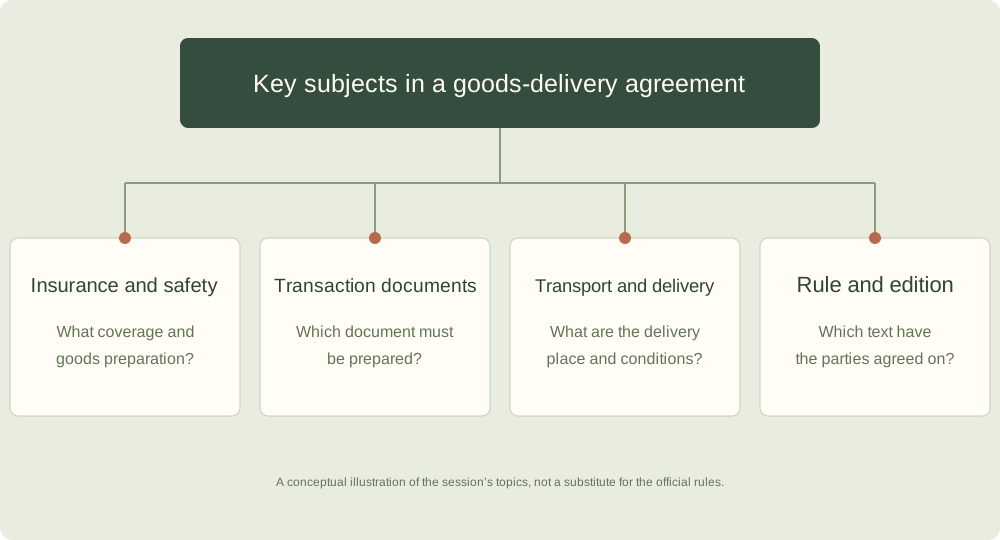
The full video is embedded here so readers can follow the examples, original sequence and emphasis. This text facilitates thematic reading but does not replace official rules, an insurance policy or a specific contract.
Matters to examine before final agreement
Rule and edition
Clearly identify the rule and agreed wording.
Documents and execution
Align documentary needs with the transport plan.
Insurance and cost
Examine the cover obtained and the cost of obligations.
Preparing the goods
Consider packaging and safety appropriate to the goods.
Source, editing method and limitations
This article is edited and adapted from the actual automatic Persian captions of the video on this page, not a word-for-word transcript. The Bandar Abbas, Iran-to-Moscow and exporter's own transport examples come from the talk. Diagrams illustrate those concepts without adding statistics or business outcomes.
Obvious transcription errors have been corrected; unclear sections, corrupted years, political generalisations and legal claims requiring independent review have not been republished as established facts.
The reference to introducing the 2020 edition establishes the talk's historical context. Upload date is not necessarily recording date. This text is not up-to-date legal, insurance or regulatory guidance.