Educational article with video
Formal export offer (FCO): what information should be clear before agreement?
A detailed article based on Mostafa Nezamparvar's lecture on formal export offers: the process from inquiry to invoice, the basis for weight and price, quality and inspection, packaging, quantity, delivery and transport, with a framework for collecting information and educational diagrams.
Based on a talk by Mostafa Nezamparvar

Full article contents
- Why should a purchase enquiry receive more than a price?
- Where the formal offer fits in the order process
- Specify the offer's date, reference number and recipient
- State the pricing basis unambiguously
- Do not sacrifice accurate information for an immediate sale
- Separate quality criteria from the inspection plan
- Clarify the inspection scope and required tests
- Specify the services and costs included in the offer
- Describe packaging with verifiable details
- Align product name, order quantity and minimum purchase
- Specify delivery terms and loading and discharge locations
- Do not confuse direct shipping, transshipment and partial shipment
- Complete the parties' details and do not copy remaining clauses without examination
- A practical structure for collecting offer information
- About this talk
Full lesson video
Overview of the lesson's topics
Why should a purchase enquiry receive more than a price?
Buyers need more than a price to decide. They want to know which goods, specifications, quantity and delivery conditions are offered. This session by Mostafa Nezamparvar concerns preparing a formal export offer, or FCO, that assembles this information clearly in one document.
In the working method described, a formal offer responds to the customer's enquiry. Rather than sending a price in a short message, the seller states proposed conditions so that the buyer can review them and discuss differences. The aim is a more complete business response with less ambiguity, not merely a longer letter.
The educator initially distinguishes preliminary and complete offers, then focuses on the complete version. He presents a sample page by page to show how a formal response can clarify buyers' questions before payment.
The article covers the components explained in this session; topics merely listed at the end are identified separately.
Where the formal offer fits in the order process
The educator begins the order process with the buyer's enquiry and uses the term LOI. It may arrive in a formal document or be established through correspondence. What matters next is clarifying product, quantity, destination and initial expectations.
After reviewing the enquiry, the seller prepares the formal offer. In the session's model, once the buyer accepts the terms, a pro forma invoice is prepared, with payment details and final agreement completed at that stage.
Preparation and dispatch, followed by the commercial invoice, are then discussed.
This sequence is the session's teaching framework, not every document needed in every transaction. The educator also mentions other documents, such as packing lists.
Differences between the final loaded quantity and the initial order are another reason to record final information precisely in the shipment's documents. Spoken example figures are not used as a calculation basis here.
In an initial enquiry, buyers may state the destination and desired payment terms alongside product and quantity. Sellers should clarify which requests they can accept and what terms they propose. Here, the FCO records that organised response; it does not automatically replace later documents.
The session explains the difference between a pro forma and final invoice through the quantity actually loaded. With weight-based pricing, the final amount relates to the quantity delivered.
Initial order information and final shipment details may therefore need reconciliation.
Permitted quantity variations should be specified in the agreement; the spoken example is not general permission to alter orders at will.
The formal offer's place in the order process described
The buyer's enquiry
Product, quantity, destination and initial expectations
Formal offer — FCO
The seller's organised response and proposed terms
Pro forma invoice
After acceptance of the terms, complete the agreement and payment information
Preparation and dispatch
Fulfilling the order as agreed
Commercial invoice
Recording final shipment information
Specify the offer's date, reference number and recipient
The offer opens with its title, issue date and reference number. The date matters because prices or terms may change. A reference identifies the particular version and may follow the business's internal numbering system.
The recipient's name, position and company should also be clear. The offer identifies whom the seller is addressing and which enquiry it concerns. This helps prevent mistakes when several negotiations run simultaneously.
The session links issue date with offer validity. Detailed price-validity terms are deferred to the next lesson, however, so this article prescribes no fixed or universal validity period.
A reference number should allow the parties to return to the same offer. The educator prescribes no particular format; a business may use numbers, dates or a combination. Function matters more than appearance: both sides should know which offer they are discussing.
When addressing the letter to a specific responsible person, the company name alone is insufficient. The session's example includes the person's name, position and company together.
A short introduction then links the offer to the recipient's enquiry.
The educator emphasises that his sample developed through practical revisions; clauses found online should not be copied without considering the transaction.
State the pricing basis unambiguously
A price should state its unit and basis: net weight, count, metres, rolls, packages or another suitable unit. For weight-based sales, both parties should understand net product weight versus gross weight including packaging.
For packaged goods, the actual weight or quantity of the contents also matters. Naming the package alone is insufficient when customers need the contents' quantity to compare prices or plan sales. Pricing units, goods quantity and packaging information should be consistent.
One account concerns a buyer requesting a quotation based on gross weight. Dividing the total price by goods plus packaging makes the apparent price per unit of weight lower, but this does not necessarily mean paying less for the same quantity of contents.
The problem begins when buyers treat prices calculated on different bases as equivalent.
When comparing offers, first establish whether the price concerns the product alone or weight including packaging. For goods sold in packages or cans, the net contents should also be clear.
Beyond price calculation, the educator treats this as a credibility issue: customers should not discover after purchase that their understanding of the actual quantity differs from what they receive.
Do not sacrifice accurate information for an immediate sale
A substantial part of the session concerns honest product presentation. The educator emphasises that ambiguity about weight, quality or specifications used to make an offer appear cheaper can damage long-term credibility. Even inexperienced customers should be able to understand the price and proposed terms.
The reasoning is that short-term gains from ambiguity can undermine long-term cooperation. The educator asks sellers not to conceal differences affecting a customer's decision, even when the customer is inexperienced. The article retains that principle without republishing generalisations about a country's people or companies.
Separate quality criteria from the inspection plan
When discussing grade, quality or standards, clarify the reference defining the term. “Excellent quality” alone does not explain assessment criteria. The lesson emphasises making the basis of product specifications understandable to buyers.
This differs from shipment inspection, which asks how the quantity and quality of ready-to-ship goods are checked and what report the buyer receives. Naming a standard alone does not explain who will examine that particular shipment.
Include only certificates and services genuinely available for the order. The article explains how to clarify quality and inspection agreements; the video cannot verify a company's current licence or a destination's certification requirement.
The example of labelling an appliance's grade shows that a label without its basis may be unclear to an overseas buyer. State which criterion or authority underlies the grading.
The article derives no equivalence between countries' standards from these examples. The point is to define precisely any label used in the offer.
Clarify the inspection scope and required tests
In the educator's example, an inspection report may include cargo quantity, package count, marking details and results of requested checks. This helps a buyer away from the loading site compare the shipment with the order.
Test types depend on the product and order requirements. The session mentions tests for contamination or composition as examples, not a single test required for every product. Before stating that inspection has occurred, clarify what is examined, by whom and what report is expected.
The educator also links inspection-company selection to customer familiarity and acceptance and service availability. This article guarantees or recommends no particular company and does not treat an inspection report as an absolute guarantee against every discrepancy.
In the inspection example, the educator refers to loading time: checking package counts and specifications, markings and shipment sampling.
Buyers care whether a report relates to the goods actually ready for dispatch. A report on an unrelated sample or a general description of factory quality does not necessarily provide information about the shipment.
The sample certificate also shows a reference number, date, relevant party, product specifications, count or quantity, packaging and markings. These details clarify the report's subject.
If a particular test is requested, identify which test was performed and what the report's result concerns; the generic label “inspected” does not answer all those questions.
Defining quality is not the same as inspecting a shipment
Quality criteria
Under which specifications, grade or defined reference is the product offered?
Shipment assessment
How, and by which body, are the quantity and quality of these actual ready-to-ship goods checked?
Specify the services and costs included in the offer
The next section covers preparation and delivery services: stowage, container loading, securing, port operations and inspection. The key question is which services the quoted price includes and what actions are planned for delivery.
Sellers should leave no ambiguity about costs included in the price or promised services. If special inspection or preparation is offered, its cost and feasibility should be included in the order calculation.
The session's port-charge and delivery-obligation examples belong to that lesson. Historical tariffs and blanket statements of parties' responsibilities are not repeated here. Costs and responsibilities must match the agreed terms, delivery rule and actual services in the transaction.
This section distinguishes stowage inside a container from merely bringing goods to the site. Referring to securing and stabilising cargo, the educator explains that delivery condition should be clear. Buyers need to know how goods are prepared for onward transport and which operations the seller's offer includes.
The discussion of terminal charges emphasises that arrival at the port does not end all operations and costs.
The article sets no fixed amount or legal definition for these charges. The session's example supports the need for sellers to identify and explain the components of their proposed service in their calculations.
If something is excluded from the price or assigned to another party, it should not be concealed in a vague phrase.
Describe packaging with verifiable details
Besides the goods, buyers need packaging information. The video mentions size, material, thickness, dimensions, net and gross weight, colour and packaging quality. Not every item applies equally to all goods; choose details relevant to the product and order.
The educator recommends stating packaging specifications separately and precisely so customers understand the condition in which goods are supplied and shipped. Any accepted tolerance or variation range should be clear; an illustrative figure in a lesson cannot be applied to another product.
The educator distinguishes packaging descriptions from descriptions of the contents. Packaging material or dimensions do not replace the product type, just as the product name does not establish container or pallet specifications. Separating them helps buyers assess each independently.
Detail is useful when it is factual and relevant. If a range of variation in size or thickness is accepted, that range should be specified.
This information tells customers what they can treat as fixed and what may vary within agreed limits. Irrelevant features should not be transferred from a sample document to another product's offer.
Align product name, order quantity and minimum purchase
In the specifications section, begin with the correct product name, then state the quantity in its appropriate unit: items, metres, rolls, bags or weight, for example. General descriptions encompassing different products are insufficient for precise agreement.
Minimum order quantity, or MOQ, appears here too. If a price applies to a specific quantity, customers need to know the limitation. Larger-order prices may differ from smaller quantities; a price should not appear applicable to every volume without explanation.
The quantity in the offer should match the customer's request and the seller's supply capability. If the response differs from the original enquiry, the offer is where to state that clearly.
This section answers the current enquiry while clarifying the offer's limits. If the requested quantity differs from the minimum available, state that difference. Product name, quantity, unit and minimum-order condition should not contradict one another across the document.
Specify delivery terms and loading and discharge locations
The lesson mentions FOB, CIF, CIP, CPT and CFR. The relevant point here is to quote prices with delivery terms; a bare figure is insufficient for comparing offers. This session is not a complete explanation of all these rules.
The loading and discharge ports or locations should also be specified. Location relates to the route and customer needs. Naming only the country may omit necessary detail when the agreement concerns a particular port.
If the offer applies only to certain destinations, state that limitation. The educator gives examples of different sales conditions by destination market. The article does not infer a fixed route or a universally best port from them.
Several ports are mentioned to illustrate the importance of the loading location in transport planning. Choosing a familiar port or the seller's usual port without considering the customer's destination may make the offer operationally unsuitable.
The article does not conclude that one port is always best for every route; the issue is aligning the stated location with the actual transport plan.
The educator also distinguishes an offer for one destination from one covering a different destination range. If a price applies only to one market or port, state that limitation. Buyers should not assume they can change destinations without review while retaining every term.
Do not confuse direct shipping, transshipment and partial shipment
Part of the session concerns transferring containers between transport units and intermediate ports. In the transshipment example, a container moves from one ship to another. The educator distinguishes this from unloading goods into a different container.
For the commercial offer, this matters to the transport plan and arrival timing. Buyers need to know whether direct shipping is proposed or the route includes intermediate transfer. Expected timing and methods should be assessed against an actual service; port statistics and vessel capacities quoted in the session are not current data in this article.
Partial Shipment is a different subject: an order is sent in several instalments. In the session's example, a multi-container order may be prepared as smaller shipments instead of being sent all at once.
Both the seller's production capability and the buyer's receiving and clearance plans affect acceptance of this method. Establish from the outset whether the buyer accepts several shipments or requires one delivery.
To explain transshipment, the video describes smaller and larger vessels connecting at intermediate ports, linking cargo from different routes into a shipping network. For an FCO, buyers need to know what transfers the proposed transport includes. An intermediate port or service schedule from an old example must not be generalised to today's order.
Partial shipment, by contrast, concerns dividing the order, not changing the means of transport. The educator describes an order whose containers cannot all be prepared simultaneously, so the seller proposes several dispatches.
Customers may reject this method because receiving or clearing goods several times requires a different plan. Clarify this before execution, not after the first part of the order is ready.
Intermediate transfer versus partial shipment
Transshipment
In the session's example, the container is transferred to another ship en route.
Partial shipment
The whole order is sent in several separate shipments; acceptance must be clear.
Complete the parties' details and do not copy remaining clauses without examination
After the initial recipient introduction, the parties' details section records fuller seller and buyer information, including names, addresses, telephone numbers, email and the responsible person's or signatory's name and position. Document number and date are also considered for traceability.
At the end, the educator introduces offer validity, origin, payment methods, order schedules, documents, force majeure and arbitration, but defers full explanations to the next session. This article therefore provides no ready-made clauses or legal instructions for these topics.
The clearer the offer, the more precisely negotiation points emerge: price, quantity, timing, packaging or shipping method.
However, the legal effect of a signature, the conditions under which an offer becomes a contract and the validity of its clauses require separate examination. The title FCO or several pages of text alone does not establish legal validity.
A practical structure for collecting offer information
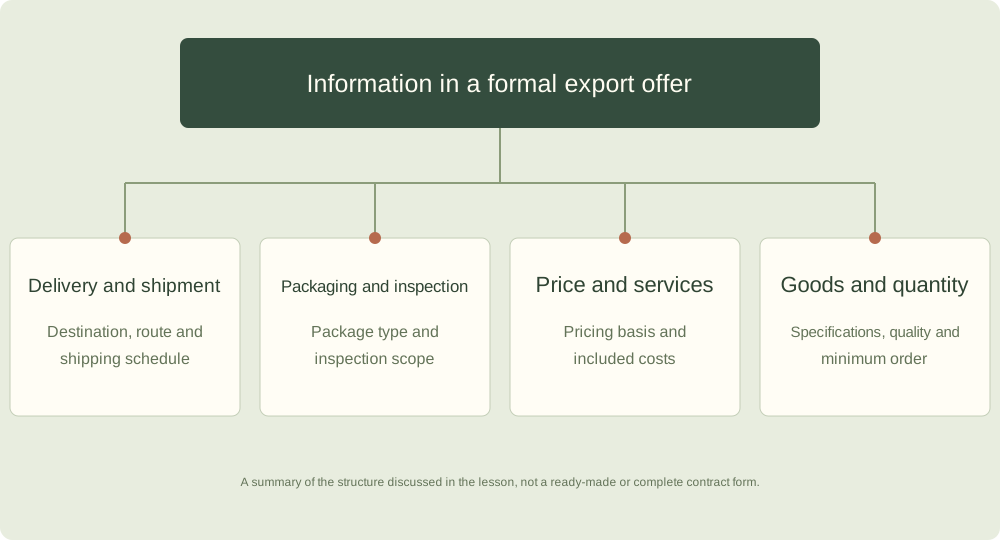
Based on the subjects explained, initial offer information can be organised into groups. This is not a ready-made contract or completed form; it gives scattered order information a place before drafting.
Four groups of offer information
- The first group identifies and tracks the document: offer title, issue date, reference number, recipient's name and position, and company. A short introduction then links it to the purchase enquiry. The parties' details section completes names, contacts and responsible persons.
- The second group defines the transaction: precise product name, quantity and unit, MOQ where relevant to price, pricing basis and packaging specifications. Clarify whether weights are net product weights or include packaging, and what variation is agreed.
- The third group concerns quality and shipment assessment: quality criteria, certificates genuinely available, inspection plans and agreed tests. Report details should allow buyers to understand the subject and scope of the examination.
- The fourth group concerns execution: services included in the price, delivery terms, loading location, destination, intermediate transfers and whether partial shipment is acceptable. These elements should align with one another and with the ability to fulfil the order.
Final price, validity, payment method, detailed execution schedule, documents and legal clauses are named at the end, but not all their details are taught.
They should not be completed by guessing or copying unrelated text. The structure identifies what information the talk actually covers and which matters still need work.
Four information groups in an offer
Document and party identification
Date, reference, recipient and contact details
The subject and pricing basis
Product name, quantity, unit, weight and packaging
Quality and inspection
Specification criteria and the shipment-assessment plan
Execution and delivery
Services, delivery terms and location, route and shipment instalments
About this talk
This article is edited and adapted from automatic Persian captions of Mostafa Nezamparvar's lesson on this page; it is neither his original written text nor a word-for-word transcript. Repetition, service promotions, unclear wording and claims requiring independent verification have been omitted. Topics merely named for the next session have not been reconstructed as complete lessons. The text explains a business offer's structure, not a ready-made contract or current legal, customs or banking guide.