Educational article with video
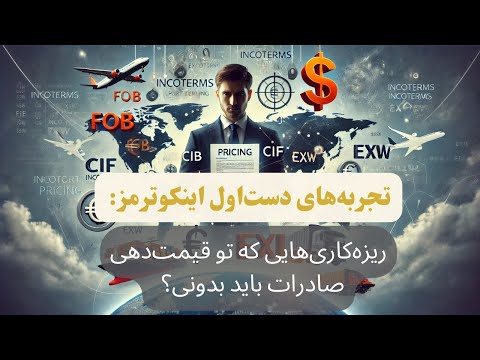
FOB Pricing: Cost Components and a Precisely Defined Delivery Port
An adaptation of the export-pricing lesson, with a separate review of ICC rules on delivery aboard a ship, export clearance and the distinction between FOB and FCA.
Based on a talk by Mostafa Nezamparvar
Full article contents
- The talk's subject: understand origin-side costs before quoting
- Why is the port's name part of the price?
- Three cost groups discussed in the talk
- Independent review of ICC rules: delivery on board, not merely crossing a border
- Stuffing and packaging: what does this video not explain?
- Summary and limits of use
Full lesson video
The talk's subject: understand origin-side costs before quoting
The educator uses FOB as the starting point for teaching export-price calculations. His central point is that exporters need to know more than the goods' price: preparation, transport to the loading point and export formalities also affect the estimate. Without clarity on these components, it is difficult to explain a quote to a customer.
The talk presents FOB calculations as a basis for thinking about other prices, including those incorporating freight and insurance.
This is a teaching method for separating costs; it does not mean all Incoterms rules can be converted into one another merely by adding amounts.
Delivery location, allocation of responsibilities and risk transfer also require separate examination.
Why is the port's name part of the price?
The video names ports in Iran, Türkiye and the UAE to show that FOB without a specified location gives insufficient pricing information. A changed agreed point may alter the route and operations needed to reach it. One figure therefore cannot be compared with another transaction's figure without explaining the delivery location.
The educator mentions intermediate ports for certain destinations. These examples report the talk, not confirmation of current routes or a requirement to use an intermediary country.
Service availability, contractual terms, carrier acceptance and route requirements must be checked separately for the actual transaction. No intermediate route is recommended here as mandatory or guaranteed.
Three cost groups discussed in the talk
Three cost groups, not every legal obligation
- The first group is packaging and preparation. Goods must be ready for the intended transport; their price at the production site does not necessarily include all preparation costs for export shipping. The video itself promises packaging details in later lessons rather than providing complete operating instructions.
- The second group is transport and handling up to delivery aboard the ship. The talk mentions road or rail transport, different vehicles and container movement in the port. The point is to recognise separate operations and costs, not to suggest every product requires all methods at once.
- The third group is export and customs formalities. The educator links these to preparing goods to leave the country. To establish contractual obligations precisely, however, distinguish export clearance, the delivery point, and import or transit formalities; the next section gives the official explanation.
Separate three groups when estimating the price
Preparation
Packaging and preparing the goods being traded
Movement
Transport and loading operations up to the agreed point
Export formalities
Export-related formalities and costs
Independent review of ICC rules: delivery on board, not merely crossing a border
Calculating costs is not the same as transferring risk
Financial estimate
Costs needed to perform the transaction's obligations are identified.
FOB delivery under ICC rules
Goods are placed aboard the ship at the agreed port of shipment; risk transfers at the delivery point.
Delivery before loading aboard
For container delivery to a carrier at a terminal, FCA's suitability should be assessed separately.
Stuffing and packaging: what does this video not explain?
At the end, the educator mentions stuffing and differing packaging conditions at destinations. The useful point is to include preparation and stowage in the calculation; assuming identical operations makes the estimate incomplete.
The recording does not specify which pallet, securing method or package a particular product requires. Its general examples cannot establish country regulations or technical loading instructions. Obtain those details from the goods' specifications, transport requirements and sources relevant to the transaction.
Summary and limits of use
Before quoting, clarify how the goods will be prepared, which route they will take, and at which port and point they will be delivered to the other party.
Then separate costs required up to that point from subsequent freight and services.
This summary organises the video's topics; it is neither a definitive tariff list nor a substitute for contract review.
The text was adapted from automatic captions without reconstructing uncertain wording. The recording date has not been independently established. The official note above was reviewed on 31 October 2026 and should be read separately from the video's historical examples and interpretations.
Official sources for supplementary review
These sources support the review notes and corrections identified in the text; they are not part of the original video talk.
- ICC Digital Library — ICCrules ↗ — Reviewed: 31 October 2026