Educational article with video
Building trust in exports: from expert answers to a professional business introduction
A detailed article adapted from Mostafa Nezamparvar's lecture on foreign customer trust: the role of credibility in orders, learning about products, responding to customers, evidence of sourcing capabilities, company profiles, catalogs, documents and long-term follow-up, with experiences and examples from the session.
Based on a talk by Mostafa Nezamparvar

Full article contents
- Customers need to see the ability to carry out the transaction
- The relationship between trust, orders and payment terms
- Demonstrate product expertise in conversation
- Clarify the requirements before quoting a price
- Explain your role as a supplier clearly
- Provide relevant evidence for a buyer who is far away
- A company profile should provide information for decision-making
- Include product specifications and conditions in your export catalogue
- Match correspondence and documents to the stage of the transaction
- Websites and social media should make real business activities traceable
- Allow time for trust to develop
- About this talk
Full lesson video
Overview of the lesson's topics
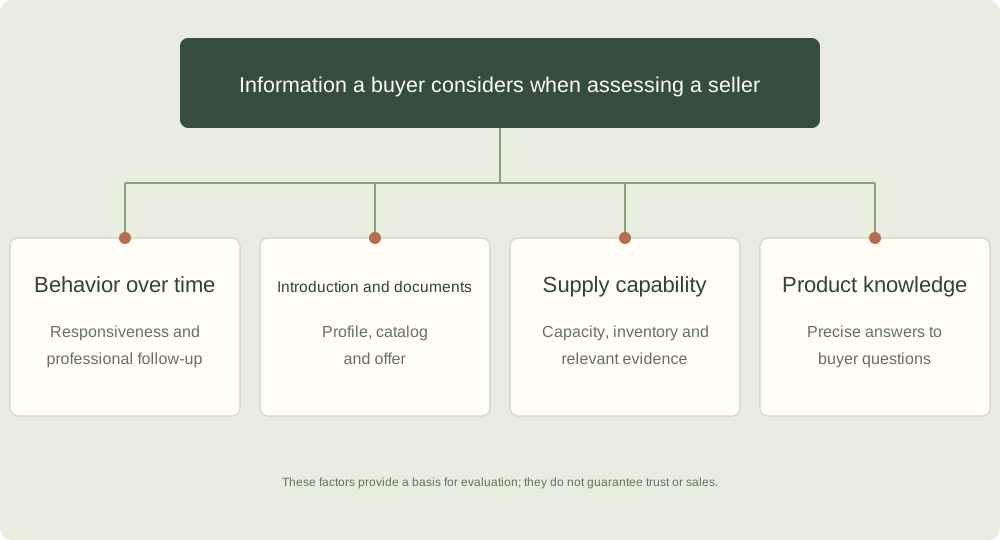
Customers need to see the ability to carry out the transaction
Before buying, an overseas customer wants to know who the seller is, how well they understand the product and whether they can fulfil the order as required. This lesson by Mostafa Nezamparvar focuses on the gap between introducing oneself as a seller and gaining the buyer's acceptance. Simply announcing availability or a price does not answer every customer question.
The question the educator recalls from the start of his career is: when we lack substantial capital and experience, who will pay us? He describes beginning online activity by obtaining basic presentation tools, such as a domain and hosting.
He then recalls entering exports and a transaction completed without meeting the customer in person.
This is his personal account during the session. Its purpose is to show that trust can develop remotely, not to prove that a transaction without a meeting is suitable for every person or order.
The discussion then distinguishes credibility from simply having money. Comparing customers' perceptions of familiar brands, the educator explains that buyers assess more than a product's visible features; the track record and credibility they associate with the seller or brand also affect their choice.
Conversely, having money does not necessarily persuade a manufacturer or customer to work with someone. Within the framework of this session, appropriate conduct and organised working methods help build credibility.
The thematic trust-building path in this lesson
Understanding the customer's requirements
A knowledgeable, relevant response
A clear presentation of supply capabilities
Relevant evidence and documents
Continued contact and assessment
The relationship between trust, orders and payment terms
The educator links trust to the conditions for fulfilling an order. In the model he describes, the seller first obtains an order and then arranges production or sourcing under agreed financial terms. For this model, the buyer must accept the other party's capability and credibility before receiving the goods. Trust-building is therefore not separate from selling in this lesson; it helps establish the basis for the transaction.
The talk also distinguishes cash payment from bank credit. The educator recalls a negotiation in which the seller preferred a credit instrument, but the buyer could not use the proposed credit arrangement and suggested cash payment. The lesson relevant to trust is to understand the other party's actual capabilities; sellers should not assume that their preferred payment method is workable for every customer.
This part of the session includes banking explanations tied to the time and circumstances of the educator's work. The article does not turn them into money-transfer instructions or financial solutions. Nor is the ability to receive an advance payment the sole measure of credibility or a transaction's suitability. The rest of the lesson focuses on how sellers can present their capabilities more clearly and address buyers' concerns.
Demonstrate product expertise in conversation
When a seller claims to export every kind of product, they may struggle to answer a customer's specialist questions. Buyers ask about differences in quality, raw materials, market requirements and conditions of use. Without clear answers, they see little reason to accept the risk of working together. Focusing on one area helps make the information needed for these conversations more precise.
Some of this knowledge develops through customer contact. The educator emphasises allowing time to learn rather than expecting a beginner to master every detail in their first exchange. Unanswered questions during negotiations reveal what information is needed from the manufacturer or specialist product sources.
A seller should be able to explain the difference between two options, not merely repeat their names. In the carpet example, questions about quality and materials are useful when the customer's answers influence the offer.
Such a conversation shows that the seller wants to understand the need and recommend a suitable product. If every answer ultimately leads to the same fixed offer, the questions alone do not demonstrate expertise.
The educator uses “opportunity cost” for the learning period and, in response to an audience question, explains that time spent also has value. The person could have done other work and earned other income during that period.
The point here is to recognise the cost of learning and experience, not to set a fixed period after which everyone will necessarily make a sale. The product and the information required affect how long learning takes.
Clarify the requirements before quoting a price
These questions should not become lengthy, aimless correspondence. The aim is to identify exactly what must be priced. When order quantity, quality or delivery time is unknown, a number alone does not give a complete picture of the transaction. An organized, relevant response demonstrates the seller’s understanding of the purchasing process.
This comparison also includes company information and images of products, production lines and loading. Customers consider these signals alongside the seller's response. In the educator's view, a low price cannot always compensate for a weak presentation of supply capabilities or poor responses.
In the glass example, differences in order quantities, materials or quality affect the response. Asking about the destination country and required timing is also part of understanding the order. These relevant questions show the customer that the seller is not sending the same ready-made price to everyone, but considers their purchase conditions.
Alongside correspondence, the educator discusses consistency between the business's presentation and the person negotiating. In the session's example, showing the responsible person in a video of the workplace or production facility makes their connection with the business identifiable.
This content should show the person's actual role; not being a manufacturer or factory owner should not be concealed through imagery.
Two responses to a glass purchase enquiry in the session's example
An incomplete response
Only a price list is sent; supply capabilities are unclear; the basis of the price is ambiguous
An order-specific response
Ask about quantity, specifications, timing and destination; introduce the business with relevant evidence; prepare an offer for that particular enquiry
Explain your role as a supplier clearly
A supplier is not necessarily a manufacturer. In the section on trading companies, the educator explains that a company can coordinate an order, packaging, transport and transaction documents while production takes place elsewhere. A professional introduction therefore does not require a claim to factory ownership.
A business introduction should make clear whether the customer is dealing with a manufacturer, sourcing company or trader, and what that business does for the order. Coordinating and delivering goods is also part of a supplier's value. The website, company profile and correspondence should explain that role clearly.
In the account of working with a factory, production and commercial functions are separate: the factory discusses the product and its manufacture, while the trading company can handle subsequent coordination, including documents, payment collection, packaging and dispatch.
The buyer then deals with someone whose role is clear. The supplier's value lies in providing and coordinating these services, not in claiming to own every part of production.
This distinction also affects website and profile content. A sourcing business should explain its supply and order-coordination capabilities. A manufacturer should place more emphasis on production capacity and facilities. Customers should not have to infer what kind of organization they face from inconsistent texts and images.
Provide relevant evidence for a buyer who is far away
When buyers cannot visit a warehouse or factory, photographs and video can improve their understanding. The educator describes sending product images for a specific customer, including a photograph showing the customer's name beside the goods, or using a video call to show current stock and production.
These tools address specific customer uncertainties: Are the goods in stock? What is the production status? Does the seller have access to the supply location? A generic product photograph does not necessarily answer all these questions. Evidence relevant to the enquiry can make the discussion more precise, although an image alone does not replace checking other transaction conditions.
These details distinguish a generic image from relevant evidence. In the educator's account, the customer asks about stock, and a photograph or call from the warehouse answers that specific question.
In another situation, showing production can help buyers understand the environment in which their order is prepared. The choice of medium should address the customer's uncertainty, rather than simply increase the number of files sent.
The video also mentions practical limits on internet access in some warehouses. Communication methods should match actual facilities. Promising a live call or immediate demonstration is appropriate only when it can be delivered. A relevant, workable response builds trust, not a promise that cannot be fulfilled.
A company profile should provide information for decision-making
A company profile is more than a short introduction. In this lesson, important information includes operating history, production or supply capacity, facilities, equipment, available quality levels, product variety and packaging options. Before lengthy negotiations, the customer should be able to assess how these capabilities fit their order.
In the factory-capacity example, the problem was not simply an unknown figure. The buyer wanted a specific quantity, but the factory also had commitments to existing customers and did not want to allocate all its production to one customer.
Had this difference been clarified earlier, both parties could have decided whether cooperation was feasible before spending more time. When presenting capacity, an overall figure must be accompanied by the realities of existing commitments and available supply.
Production variety is not merely a list of product names. The educator refers to packaging, quality and material options: customers need to understand which changes they can request. Seeing these capabilities may lead a buyer to raise another need they had not realized the company could supply.
Include product specifications and conditions in your export catalogue
An attractive catalogue without practical information is not enough for an export purchase. Buyers need to know the product's specifications, how it is stored, which packaging options are available and what transport limitations apply. This information must reflect the product's actual characteristics.
One experience discussed in the session concerns goods damaged by cold along the route or at the destination. The educator explains that the buyer had mentioned the cold, but the seller did not know enough about the product's tolerance.
The lesson he draws is the need to understand storage conditions before accepting an order. This example is not a technical instruction on the storage temperature of any particular product.
The discussion also covers packaging strength and how cartons are positioned. Knowing stacking limits, handling conditions and product sensitivities can help in choosing an appropriate shipping method. The information needed for these decisions must be established for the specific product, rather than relying on its apparently simple or familiar appearance.
In the discussion of cold damage, an attendee asks about the buyer’s responsibility to provide information. The educator’s answer matters: the buyer had described destination conditions, but the seller did not know how well the product could withstand them. He attributes the weakness to his own insufficient product knowledge.
Simply asking about conditions at the destination is therefore not enough; the seller must be able to compare the reported conditions with the product's actual characteristics.
Another example is packaging a fragile product such as eggs. The educator draws attention to how packages are positioned and their ability to withstand stacking. In such cases, shipping and packaging information is not a minor catalogue detail; it can affect whether goods arrive intact.
The article gives no permitted stacking figure because the session provides no generally applicable technical instruction of that kind.
The educator also describes receiving an image of product packaging already in the destination market. It helps clarify market expectations and prompts questions about packaging size and form.
Seeing a sample can prompt better questions, but does not replace assessing packaging suitability for your own product and route. The aim is to learn from actual order information and improve the next offer.
Information that makes a catalogue useful for purchasing
The product itself
Specifications, materials and available quality
Storage and route
The product's actual sensitivities under destination and shipping conditions
Packaging
Package form, arrangement and load-bearing limits
The customer's choice
Options that can be supplied for that particular order
Match correspondence and documents to the stage of the transaction
A request for a quotation, a formal offer and a pro forma invoice serve different purposes. The video mentions formal offers, price lists, pro forma invoices and commercial invoices. Its main emphasis is that a business response should not be limited to a figure and bank account details.
Order specifications, loading conditions and destination are among the matters that should be clear in the transaction documents. Presenting this information systematically helps customers understand exactly what an offer includes and which matters still require agreement. This part of the session introduces the importance of documents; it is not comprehensive training in drafting or legally reviewing them.
In the educator’s view, how an offer is sent is part of professional conduct. A buyer requesting a quotation or pro forma invoice expects the terms relevant to that stage. If the reply contains only an amount, they must extract the remaining information through separate messages. This incomplete response can make it harder to evaluate the seller’s capability.
Completing forms is not merely a cosmetic exercise. Sellers must understand the information they enter and obtain reliable answers to any uncertainties before sending it.
The session supports learning through doing and asking questions when problems arise. Using a ready-made template should not lead to sending information whose meaning or feasibility the seller does not understand.
Websites and social media should make real business activities traceable
A website is one place customers examine when assessing a supplier. A manufacturer's introduction differs from that of a sourcing company or trader; content should clarify the business's role, products and relevant capabilities. After seeing an advertisement or receiving a seller's name, customers should be able to find the information they need.
This lesson also highlights social media's role in maintaining contact. Publishing content about products, production or loading allows an audience to follow a business's activities over time. The aim is not merely to appear on several networks; what matters is that the audience sees useful information and evidence of continuing activity.
A customer may ask for prices several times without buying. The educator recommends maintaining a professional response and not dismissing someone merely because they repeat an enquiry. However, the session distinguishes a genuine customer from a suspicious or fraudulent message; maintaining contact does not mean ignoring warning signs.
The recommendation to respond well to repeated inquiries comes from the same perspective. A seller may think the contact has requested prices several times without intending to buy, while the buyer may still have unresolved questions about cooperation. The quality of the new response still matters.
This advice is coupled with checking whether the contact is genuine; it does not mean trusting every message without scrutiny.
Allow time for trust to develop
To put the discussion into practice, review your company profile, catalogue, initial responses and online presence from the buyer's perspective:
Review questions
- Is your role clear?
- Do you know the product specifications?
- Is the capacity actually available clearly stated?
- Are the order conditions established before pricing?
- and can your audience follow your activities?
These questions help identify weaknesses that can be corrected. Time and professional conduct create opportunities to build trust, but no transaction’s outcome is guaranteed in advance.
At the end, the educator mentions someone who considered changing fields after a period without sales but later achieved a result. The story illustrates how difficult it can be to endure the initial period.
This adaptation derives no fixed timetable or promise of success for everyone from that account. One person’s experience does not show that every activity succeeds simply through persistence.
He also mentions market changes, competitors leaving or changing activities, and shifting conditions that can create new opportunities. For this article, the point is to maintain professional relationships and visibility so that the seller can respond to an opportunity. Remaining in the market should involve learning and improving weaknesses in business introductions, product information and responses.
For a practical review, trace the path from the initial request to subsequent follow-up:
Reviewing the order process
- the requirements are clarified;
- a knowledgeable, appropriate response is given;
- supply capabilities are presented through relevant information and evidence;
- Transaction terms are clarified in the appropriate document;
- and professional contact continues.
If information is missing at any stage, identify and complete it. This sequence is a thematic synthesis of the session's main points, not a substitute for the process specific to each order.
About this talk
This article is a rewritten, thematically organized adaptation of Mostafa Nezamparvar’s lesson in the video on this page, based on its automatic Persian captions; it is not a word-for-word transcript. Spoken repetitions, promotional passages, unclear phrases and broad claims requiring independent verification have been removed. Examples are presented as experiences recounted in the session, not guaranteed outcomes for all businesses.